Lean Six Sigma Yellow Belt
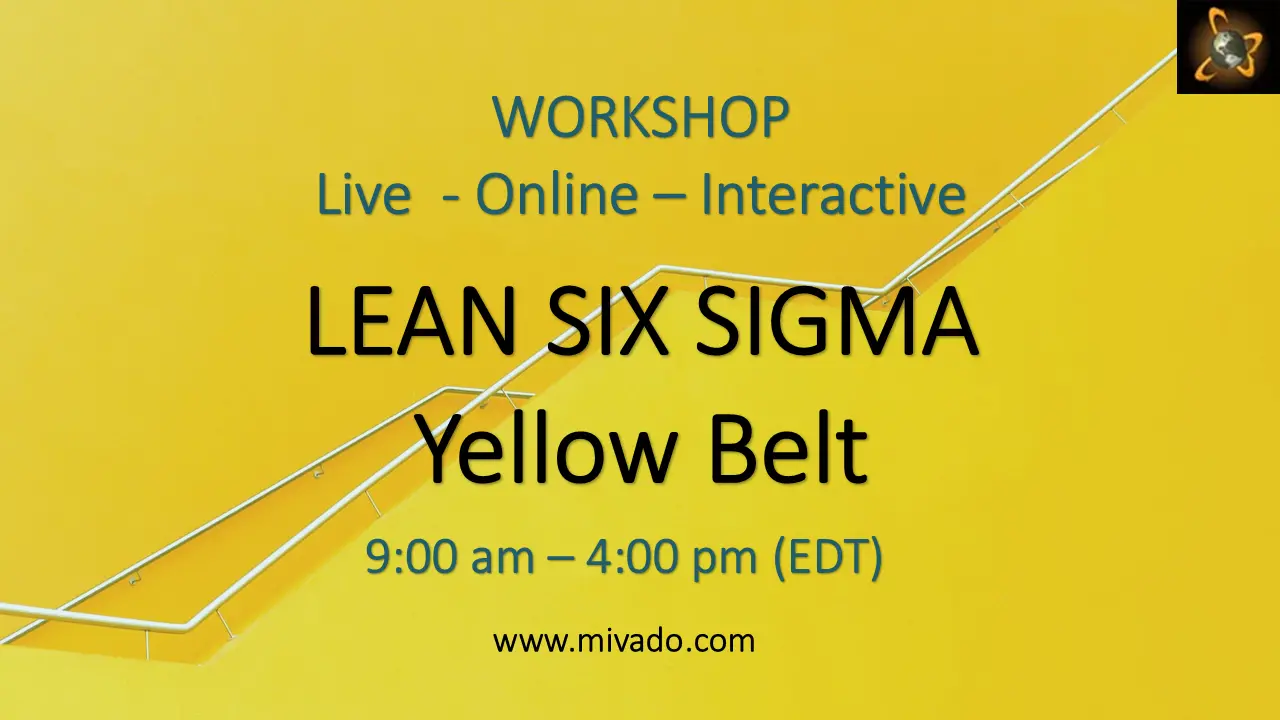
Lean Six Sigma Yellow Belt
2 days of Training
Description
The Lean Six Sigma Yellow Belt program is a foundational certification course designed to provide participants with a comprehensive understanding of the DMAIC (Define, Measure, Analyze, Improve, Control) methodology. Unlike deeper technical tracks, this training focuses on practical, “low-barrier” tools that can be applied immediately to improve workplace efficiency and reduce errors.
Learning Objectives
- By the end of this program, participants will be able to:
- Differentiate between Lean (speed/waste) and Six Sigma (quality/variation).
- Identify the 8 Wastes (DOWNTIME) in any business process.
- Support Green and Black Belt projects with accurate data collection.
- Utilize basic root cause analysis tools to solve localized problems.
- Understand and interpret basic process maps and performance charts.
Content
| Module | Topic | Key Tools & Concepts |
| Module 1 | Introduction | History of LSS, Belt hierarchy, the “Cost of Poor Quality.” |
| Module 2 | Define Phase | Project Charters, Voice of the Customer (VOC), and SIPOC diagrams. |
| Module 3 | Measure Phase | Data types, Check Sheets, and Basic Process Mapping. |
| Module 4 | Lean Fundamentals | The 8 Wastes, 5S, Visual Management, and Just-in-Time. |
| Module 5 | Analyze Phase | Root Cause Analysis (5 Whys), Fishbone (Ishikawa) Diagrams, and Pareto Charts. |
| Module 6 | Improve & Control | Brainstorming techniques, Standard Work, and Control Plans. |
Why should you attend
This training is ideal for individuals who want to improve their department’s performance without necessarily becoming full-time data scientists.
- Front-line Staff & SMEs: Those who do the actual work and see the waste daily.
- Junior Managers/Team Leads: Who need a framework to manage small improvements.
- Project Stakeholders: Anyone working on a team led by a Green or Black Belt.
- Career Starters: Individuals looking to bolster their resumes with a globally recognized methodology
Training Methodology
We utilize a Blended Learning approach to ensure the concepts “stick”:
- Interactive Lectures: Theoretical grounding in LSS principles.
- The “Lego” Simulation: A hands-on activity where participants run a mock production line, identify bottlenecks, and apply Lean fixes in real-time.
- Case Study Analysis: Reviewing real-world examples of how a Yellow Belt’s data collection saved a company time/money.
- Knowledge Checks: Short quizzes after each DMAIC module to prepare for the final certification exam.
Key Takeaway
The ultimate takeaway is the transition from reactive problem-solving (putting out fires) to proactive process management (preventing fires). Participants leave not just with a certificate, but with a “new set of eyes” capable of seeing hidden inefficiencies in any environment—from a manufacturing floor to a digital marketing agency.
Note: A Yellow Belt is often the most cost-effective way for an organization to build a “Culture of Continuous Improvement” because it empowers the people closest to the work to fix the work.
Eligibility Criteria of LSSYB
There are no prerequisites to take up the Lean Six Sigma Yellow Belt examination.
Exam Format
- No. of Questions: 60 Questions (Includes Multiple Choice Questions and true/false questions)
- Exam Duration: 120 minutes (2 Hours)
- Exam Result: Should achieve a minimum score of 230 points out of 300 points
- Type: Closed-book exam